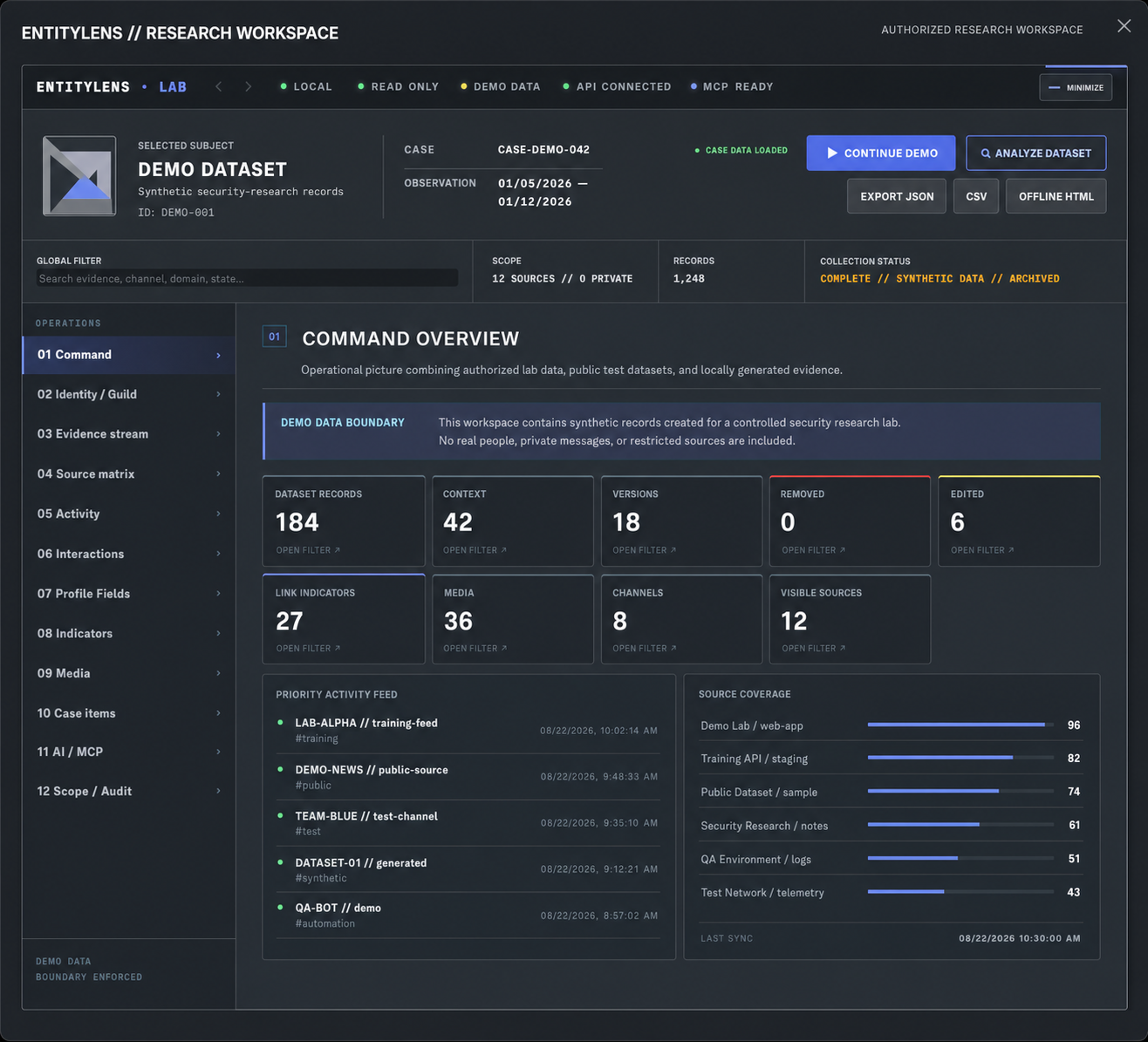
EntityLens began as an engineering problem: how can a researcher work through a large body of authorized information without losing scope, provenance, recovery state, or the distinction between evidence and analysis? I designed the workspace around local control, explicit operator actions, and clear boundaries between collection, storage, visualization, and AI-assisted review.
Design goals
- Keep case data and analysis state local to the researcher’s machine.
- Preserve provenance while normalizing records for search, filtering, pagination, and visualization.
- Make long-running work stoppable, resumable, and recoverable without tying it to an open interface.
- Provide useful AI assistance without granting an AI client write access to source systems.
- Support evidence-oriented exports while keeping scope and responsible-use boundaries visible.
System architecture
- Analytical workspace
A React and TypeScript interface organizes cases, navigation state, structured queries, filters, pagination, and interactive summaries.
- Evidence pipeline
Operator-initiated workflows validate scope, normalize authorized records, and retain provenance before information reaches the case repository.
- Local data layer
Case persistence, immutable analysis snapshots, search indexes, report state, and exports remain separated from the interface layer.
- Background operations
Native processes support cancellation, retry, checkpoints, partial recovery, and continued operation when the workspace window is closed.
- Read-only AI boundary
A local MCP service exposes only the frozen snapshot assigned to an analysis job, keeping AI-assisted review isolated from live collection and write operations.
Reliability and evidence quality
Collection and analysis maintain independent state so one workflow cannot silently overwrite another. Case snapshots are fixed when analysis begins, reports are checkpointed, and partial results can survive cancellation or process failure. These choices make the workspace predictable during long-running research and make exported findings easier to trace back to their supporting records.
Responsible-use boundary
EntityLens is intended for legitimate OSINT research, security analysis, moderation support, and authorized investigative work. It works only with records the operator is permitted to review, does not bypass access controls, and does not automatically begin collection when a subject is opened. Public documentation and this demonstration intentionally omit investigative methodology, real records, credentials, and sensitive implementation details.
What this project demonstrates
The project combines application engineering with security judgment: desktop integration, local persistence, high-volume information design, resilient background processing, evidence-aware reporting, automated testing, and a deliberately constrained AI interface. The result is not simply a dashboard—it is a case-oriented research system designed around control, traceability, and recovery.